
The molecule that holds the instructions of life is 2 nanometers wide. Until recently, seeing it in motion required specialized software, expensive licenses and a powerful computer. Today it fits in a link.
At GETS we built DNA 3D, an interactive double-helix viewer that runs in any browser, on phone or computer, with nothing to install. It is not an animation: it is a model built from real data, the first 72 letters of the human insulin gene (INS gene, chromosome 11).
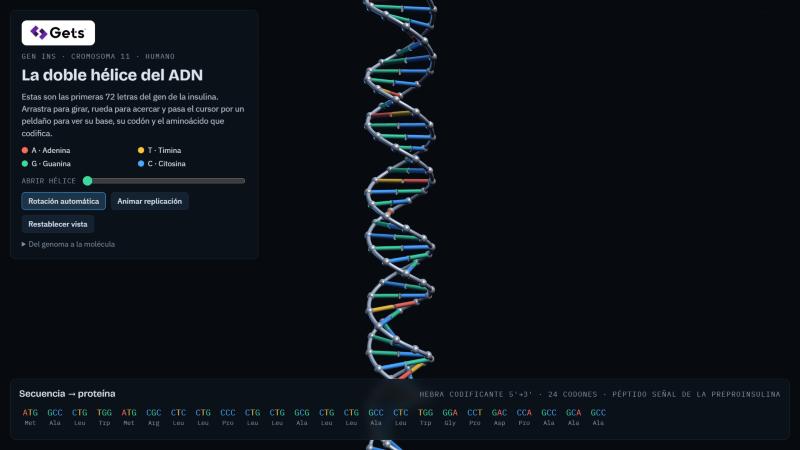
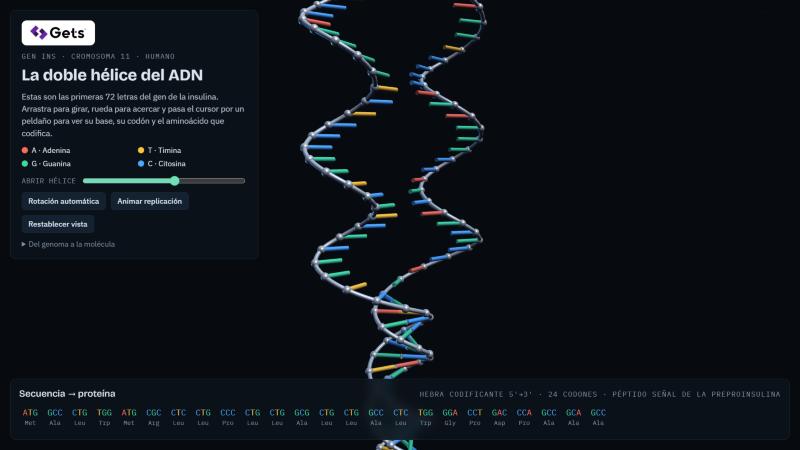
What you can do in the viewer
- Rotate and zoom the molecule with your finger or mouse and see it from any angle.
- Identify each base: adenine, thymine, guanine and cytosine, with their hydrogen bonds (2 in A–T, 3 in G–C).
- Unzip the helix and animate replication to see how the two strands separate when the cell copies its DNA.
- Read the genetic code: the sequence is grouped into codons and translated into amino acids. Met‑Ala‑Leu‑Trp… is the real start of preproinsulin.
- Travel from genome to molecule: 3.1 billion base pairs, 23 chromosome pairs and about 20,000 genes, on one scale.
The architecture behind it
What matters is not the drawing but how it is built. DNA 3D uses the same architecture we apply in our visualization projects, organized in four layers:
- Data. The base sequence is the source of truth. Change the sequence and the molecule rebuilds itself, with its colors, codons and amino acids.
- Scientific model. Geometry is computed from real measurements: 2 nm diameter, 10.5 base pairs per turn, 3.4 Å between rungs and the strand offset that forms the major and minor grooves.
- 3D rendering in the browser. WebGL and Three.js draw the scene with real-time lighting and materials, using the device's graphics card.
- Interaction. Pick each base with the cursor, controlled animations and an interface adapted to touch screens.
Everything ships as a lightweight web page on its own subdomain with HTTPS. It is the same technology behind Regata Cartagena, our 3D boat race across the bay: a 3D world that opens with a link.
What this architecture opens up in medical innovation
If a viewer can turn a sequence into a molecule anyone understands at a glance, it can also help explain, teach and decide in healthcare:
- Medical and nursing education: virtual labs where students handle molecules, cells and organs instead of memorizing flat images.
- Patient education: showing a family what a mutation is or how a treatment works, on a phone and in plain language.
- Clearer clinical reports: genetic and lab results paired with a visualization the doctor can explain during the visit.
- Anatomy and planning: 3D models of body structures for training and communication between teams.
And in genetic engineering and biotechnology
For labs, universities and biotech companies, the data layer can connect to standard scientific formats such as FASTA, GenBank or PDB:
- Visualize sequences and variants: locate a mutation within a gene and see which codon and amino acid change.
- Explain gene editing: show in 3D where a tool like CRISPR cuts and what happens to the sequence.
- Protein structures: explore three-dimensional models for teaching and science outreach.
- Research outreach: turn a paper or thesis into an interactive experience shared with a link.
What we offer at GETS
We design and build this kind of solution end to end:
- Custom scientific and medical 3D viewers for web and mobile.
- Data integration: scientific files, APIs, databases and our ERP, with secure access.
- Artificial intelligence that explains in natural language what the user is seeing, with our GETS AI agents.
- Full software engineering: architecture, development, testing, deployment on your domain and support.
- Mobile apps and interactive experiences for universities, clinics, labs and brands.
DNA 3D is an educational and visualization tool. It does not perform genetic analysis or replace a medical diagnosis.
Frequently asked questions
Do I need to install anything to try it?
No. Open adn.gets.com.co in your phone or computer browser.
Can it be used with other sequences or our own data?
Yes. The molecule is built from the sequence, so we can connect it to your own data and formats.
Can you publish it with our brand and on our domain?
Yes. We deliver it with your visual identity, on your domain and with HTTPS.
Try DNA 3D, share it with your team and tell us what you'd like to see in 3D.
Do you run a lab, clinic, university or biotech project? Let's design your next tool together.